
HITEPOZZO® Precision-Classified Fly Ash For Modern Concrete
HITEPOZZO® is Hi-Tech Fly Ash's engineered range of precision-classified fly ash, developed to deliver consistent fineness, reliable pozzolanic performance and batch-to-batch quality across cement, ready-mix concrete, precast and infrastructure applications worldwide.
Understanding HITEPOZZO®
Discover what HITEPOZZO® is, how classified fly ash differs from raw fly ash, and why precision classification delivers consistent performance in modern concrete.
What is HITEPOZZO®?
HITEPOZZO® is the registered product brand of Hi-Tech Fly Ash (India) Private Limited, representing a family of precision-classified fly ash and ultra fine fly ash engineered for modern concrete. Each grade is manufactured to a defined fineness specification, tested under an ISO 9001:2015 quality system, and supplied with a Certificate of Analysis to ensure consistent, batch-to-batch performance.
What is Fly Ash?
Fly ash is a finely divided mineral powder collected from the flue gases of coal-fired thermal power plants. Rich in reactive silica and alumina, it is widely used as a Supplementary Cementitious Material (SCM) to improve concrete workability, long-term strength, durability and sustainability while reducing Portland cement consumption.
What is Classified Fly Ash?
Classified fly ash is produced by processing raw fly ash through precision air classification, separating particles by size to achieve controlled fineness and a consistent particle size distribution. The result is a high-performance material with predictable workability, strength development, durability and compliance with international specifications.
Understanding the HITEPOZZO® Grading System
Raw fly ash naturally varies in particle size, fineness and performance depending on its source. HITEPOZZO® eliminates this variability through precision air classification, producing engineered grades with controlled particle size distribution and consistent batch-to-batch performance for demanding concrete applications.
What Does the R-Value Mean?
Every HITEPOZZO® grade is defined by one measurable engineering parameter — the maximum percentage of material retained on a 45μm sieve.
- ▸ R34 → Maximum 34% retained
- ▸ R12 → Maximum 12% retained
- ▸ R25 → Maximum 25% retained
- ▸ R5 → Maximum 5% retained
As the R-value decreases, particle fineness increases, resulting in improved particle packing, higher surface area and greater pozzolanic reactivity.
Consistency You Can Measure
Every HITEPOZZO® shipment is manufactured to its specified fineness grade, tested under our ISO 9001:2015 quality management system and supplied with a Certificate of Analysis. Third-party inspection is available upon request to provide complete confidence in product consistency and compliance.
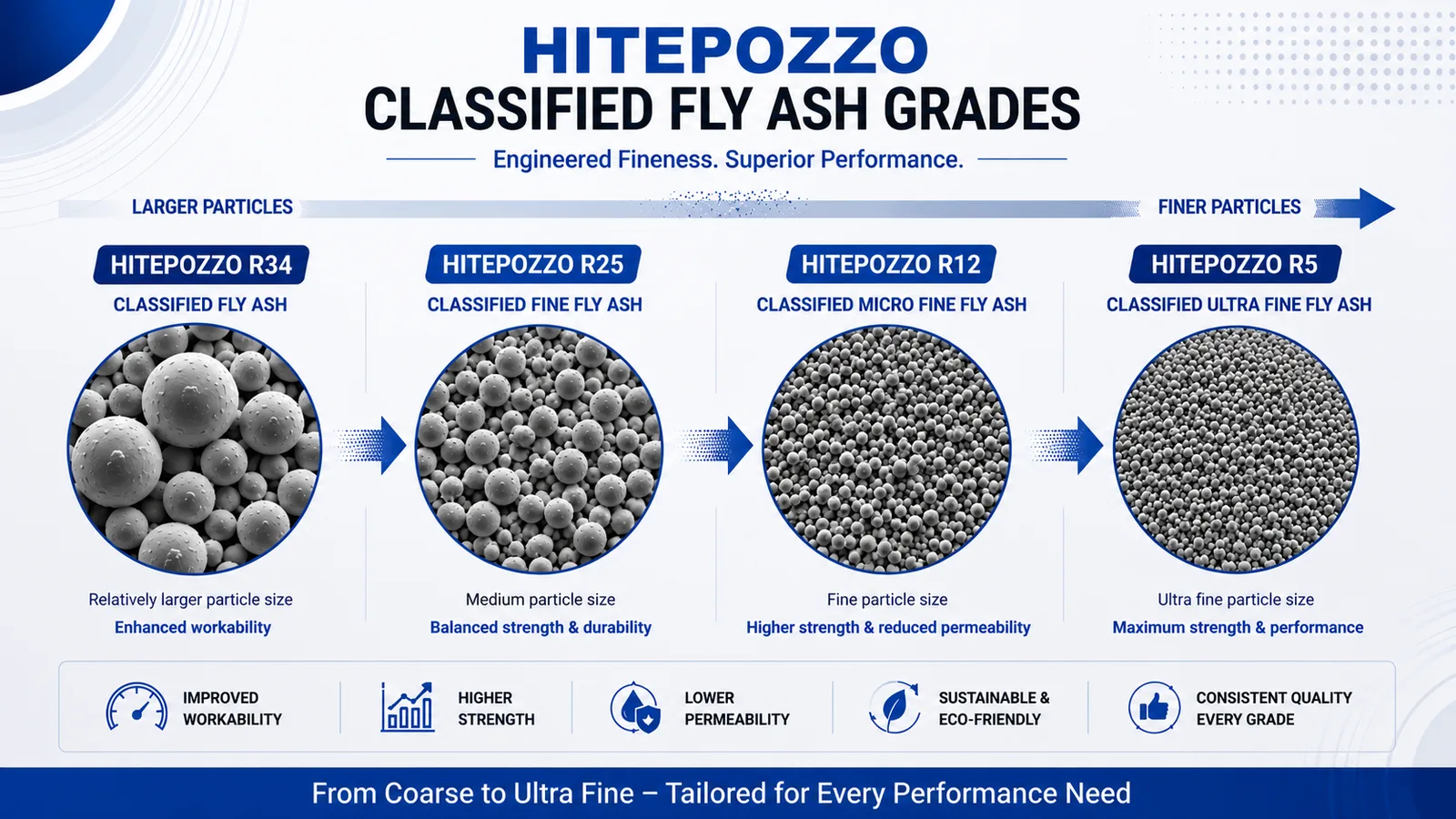
From R34 to R5, particle size progressively decreases while fineness, particle packing and pozzolanic reactivity increase. Each grade is engineered for different concrete performance requirements.
Note: Lower R-values indicate finer material but do not automatically make one grade superior. The optimum HITEPOZZO® grade depends on project specifications, concrete performance requirements and applicable international standards.
Why Classification Makes the Difference
| Parameter | Raw Fly Ash | Precision-Classified HITEPOZZO® |
|---|---|---|
| Particle Size Distribution | Naturally variable | Precision-classified to a defined fineness |
| Batch Consistency | Depends on ash source and combustion conditions | Engineered for consistent batch-to-batch performance |
| Fineness | Variable | Defined by the HITEPOZZO® grading system (R34, R25, R12 & R5) |
| Concrete Performance | May vary between batches | More predictable workability and strength development |
| Pozzolanic Reactivity | Variable | More consistent due to controlled particle size |
| Quality Verification | Supplier dependent | Every shipment supplied with a Certificate of Analysis |
| Standards Compliance | Depends on source material and processing | Manufactured to applicable ASTM C618, BS EN 450-1 or IS standards depending on grade |
| Traceability | Limited | Full batch traceability through documented quality control |
Technical Note: Raw fly ash quality varies depending on its source and processing. Precision classification improves consistency by controlling particle size distribution and manufacturing each grade to defined engineering specifications.
Choose the Right HITEPOZZO® Grade
Every HITEPOZZO® grade is engineered to a defined 45 μm residue threshold, allowing concrete producers and engineers to select the most appropriate fineness for their application.
Bespoke Classification Solutions
Standard grades don't always meet every project's requirements. When they don't, our engineering team can develop a classification solution tailored to your technical specification.
Custom Classification
Classification to a specified 45μm residue threshold, particle size distribution or specific surface area (m²/kg) beyond the standard HITEPOZZO® grades.
Flexible Supply & Packaging
Available in bulk vessels, jumbo bags, container liners or customised packaging to match project logistics and handling requirements.
Project-Specific Solutions
Classification developed to satisfy customer specifications, consultant requirements or regional standards where standard grades are not suitable.
Technical Engineering Support
Our engineering team works with customers from specification review through trial production and commercial supply to ensure the right product for the application.
Custom classifications are developed subject to technical feasibility, production capability and minimum commercial quantities.
Need Help Selecting the Right HITEPOZZO® Grade?
Whether you need technical documentation, sample evaluation or a bulk supply quotation, our engineering team is ready to help you select the right HITEPOZZO® grade for your project.
FAQ
Why is fly ash used in concrete?
Cement hydration produces calcium hydroxide as a byproduct — a compound that adds little strength on its own. Fly ash's reactive silica reacts with this calcium hydroxide in a secondary reaction to form additional calcium silicate hydrate (C-S-H) gel, the same compound that gives concrete its strength. This secondary reaction increases long-term strength, reduces permeability, and improves durability.
Does coal source affect fly ash quality?
Coal source can influence fly ash's raw characteristics, which is exactly why classification exists. Every incoming batch is tested before it enters our process, and only material that meets our intake specification moves forward. Combined with long-term relationships with established power plant partners — several with their own captive mines — this keeps input quality consistent long before classification even begins.
Can fly ash absorb moisture and form lumps?
Yes, unprocessed fly ash is hygroscopic and can absorb moisture, causing lumps if handled poorly. HITEPOZZO fly ash is protected through specialized handling and packing measures at every stage — from unloading through storage and shipment — arriving in the same condition it was tested in.
What percentage of cement can be replaced with fly ash?
Replacement levels vary by application and mix design, typically up to 35%. This isn't just a technical substitution — properly classified fly ash allows cement content to be reduced without compromising performance, offering real cost savings alongside the durability and workability benefits.
What's the difference between fly ash and cement?
Cement is a hydraulic binder — it reacts directly with water to form the primary binding compound. Fly ash is a pozzolanic material — it doesn't react with water on its own, but reacts with the calcium hydroxide cement produces during hydration to form additional binding compound. That's why it partially replaces cement rather than substituting it entirely.